
Editor’s Note: Text in this transcript has been revised from the original 2018 audio recording to align with standards of objective journalistic reporting, precise constitutional terminology, and to improve clarity. Wording in the narrator transitions originally adopted language that validated one perspective on state control (e.g., "TPLF came to power") or used imprecise political framing. The transcript has been updated to reflect precise institutional terminology ("member states within the ruling coalition" and "the coalition assumed governance") and neutral framing to maintain objectivity between the differing viewpoints presented by interviewees. Sections of the transcript containing text modifications from the original audio are marked with an asterisk (*), although some may have been missed; the original 2018 audio broadcast remains unedited.
Original Broadcast Date: Aug. 6, 2018
Transcript Published: Oct. 24, 2026
Archival audio clips of U.S. Congressional hearings featured throughout this program are sourced from C-SPAN public record archives.
Click here for the audio and show notes.
Transcript
Dr. Weldu Weldeyesus: [00:00:00] They don't even want to call the government EPRDF. They want to call it Woyane or TPLF. That's it.
Rutha Bahlibi: [00:00:08]That was Dr. Weldu Weldeyesus. TPLF is one of the four regional parties representing member states within the ruling coalition in Ethiopia.* TPLF is short for the Tigrayan People's Liberation Front. Here's Tewodrose Tirfe speaking at the 2017 U.S. Congress hearing on Ethiopia.
Tewodrose Tirfe: [00:00:25] "Good afternoon, esteemed members of the subcommittee on Africa. On behalf of the organization I represent, Amhara Association of America; Ethiopian Americans across this country; and all Ethiopians who have suffered the unconscionable brutality at the hands of the Tigray People's Liberation Front -- the ruling party of Ethiopia -- the Ethiopian government, the TPLF government mainly--."
Dr. Weldu Weldeyesus: [00:00:49] All of them are administering their own regions, their own people, with their own language, with their own state constitution, so there is no way that the Tigrayans would exert any control over them. The Tigrayans are only administering themselves in Tigray. And when we look at the federal level, there are only three ministers out of the close to 30 ministerial positions in the country. The great majority of them are under Amhara and under the Oromo, so they are the ones who would be running the country. So how would this be brought to argue that there is Tigrayan dominance of all this.
Within the EPRDF, the executive committee is composed of 36 people. Each political party sends nine people. When we take the EPRDF Council, each party contributes 45 people--no party has more or less. So in terms of voting, there would be no way that the TPLF would exercise greater control. So how on earth would it be possible for people to argue that there is a very strong TPLF domination or control of the Ethiopian government -- it doesn't hold any water. In fact, it is the strong rhetoric of the opposition, mainly the vocal diaspora, that has been misleading the mainstream media. They have taken control, and then they happen to convince not only ordinary people but even leaders of the various countries. They say that the Ethiopian government is under the control of TPLF, which is not true.
Dr. Edmond Keller: [00:02:54] It's a complicated story and you have to listen to all of it to get it [laughter], and then you may need some help.
Rutha Bahlibi: [00:03:01] That was Dr. Edmond Keller, speaking on the complexity of the coalition's structure.* Here is Deacon Yoseph Tafari speaking to U.S. Representative Karen Bass at the 2017 U.S. hearing.
Deacon Yoseph Tafari: [00:03:16] The history of TPLF, the EPRDF, is woeful in terms of having to cooperate and work with any opposition group -- with anyone.
U.S. Rep. Karen Bass:[00:03:26] Is there a dialogue that's taking place?
Deacon Yoseph Tafari: [00:03:28] There is, but all we have to do is go back 40 years of their history to see how we see this type of dialogue would really come to fruition.
Rutha Bahlibi:[00:03:40] Forty years ago. That's before the TPLF and its partner parties within the EPRDF coalition assumed governance, back to its early days.*
Dr. Paulos Milkias: [00:03:46] Very, very smart cookie these guys [TPLF].
Rutha Bahlibi: [00:03:49] That's Dr. Paulos Milkias.
Dr. Paulos Milkias: [00:03:51] Because they are very small in number--they represented only six percent of the Ethiopian population. They fought against the Derg; Mengistu Haile Mariam, the Derg, had an army of half a million, and these guys actually went from the schools. They never even had handled any guns. They started a guerrilla warfare like Mao Zedong, Ho Chi Minh, Che Guevara, Fidel Castro, and so on. They started from there -- small numbers of students -- and ultimately succeeded to defeat all these groups.
They defeated first the EDU (Ethiopian Democratic Union)--the Ethiopian democratic movement led by right-wing pro-monarchist groups like the one led by Ras Mengesha Seyoum. And they defeated the Marxist group called the EPRP [Ethiopian People's Revolutionary Party], and then ultimately, they defeated the Derg. They [the Derg] were the largest army in Africa, mind you. These were just small groups of people. They sacrificed maybe about 20,000¹ TPLF soldiers [who] died in that war. But it's nothing when you consider the number of soldiers that died for the side of the Derg.² They just succeeded to take over power, so whether they create enemies or not for themselves -- they succeeded to control power, and it's not a very easy thing to do for anybody.
Rutha Bahlibi: [00:05:16] Here is former TPLF member Besrat Amare narrating how the party was formed. He says it all started with the student movement.
Besrat Amare: [00:05:26] And this student movement, I have summarized their issues into three categories. Number one issue as I said was land to the tiller, the second question was democracy to the nation, the third was equal rights of nations and nationalities.
The founders of the TPLF and other students who were active during the student movement were unable to push forward peacefully for the issues that they were trying to mobilize the Ethiopian people [for], so they departed from their peaceful movement, and then mobilized their resources into armed struggle. The TNO was the Tigrayan National Organization, founded in September 1974, after the military junta took power. It was not for armed struggle; it was a movement within the student circle. The TNO was the organizing factor, the mobilizer. But when the armed struggle commenced, the name was changed to Tigray People's Liberation Front.
The TNO dispatched two groups from its members: one to Eritrea to find the Eritrean liberation movements, seeking help — weapons and training; the other group into western Tigray — 10 university students would go to Dedebit with five nonautomatic weapons, and they would launch the armed struggle on Feb. 18, 1975.
Rutha Bahlibi: [00:07:38] During this period, the EPRP faced mounting military setbacks from both government forces and rival insurgent groups.*
Dr. Paulos Milkias: [00:07:42] Then they started to go to the North. Where did they go? They went to Asimba. That is in Tigray, to create a guerrilla army. Now at the same time, the TPLF was being created over there in Tigray and they are Tigrayans. It's their own territory, their own nationality, nation. And then the EPRP started to have this grandiose idea about themselves and they said 'you are representing an ethnic group, one ethnic group which is Tigray. We represent all of Ethiopia and therefore you have to take orders from us.' They [TPLF] said 'oh no way, we are not going to take orders from you.' And that is how they fought and then they destroyed them. The TPLF destroyed the EPRP in Asimba. And then after that they destroyed the EDU, which was the right-wing monarchist group. That was the beginning of the strength over there.
Besrat Amare: [00:08:38] The EPRP was formed way before the TPLF was founded, [they were] perhaps about seven, six years older than the TPLF. And it was formed outside of Ethiopia, which is still the product of the Ethiopian student movement. And the difference between them–the EPRP, the Ethiopian People's Revolutionary Party–[it] was a multiparty organization. But in its strategy, there were two differences. The TPLF's emphasis in the Ethiopian political assessment was the right of nations and nationalities to self-determination, up to secession.
The EPRP believed the same thing, but the emphasis that the TPLF gave to the nations and nationalities' sovereignty was greater, and it [TPLF] counted [it] as the number one problem in the Ethiopian political problem. The EPRP, on the other hand, believed, well, if we run class struggle, the problem of repression of the nations and nationalities will be resolved through class struggle. 'We don't have to give much emphasis to it,' was their opinion, and the emphasis was on land reform, on land to the tiller and other issues. So this was a major difference in the two groups.
The second difference that they had was the TPLF's stand on protracted armed struggle was firm. ‘The only way to win our objectives,’ said the TPLF, ‘is through armed struggle, through protracted armed struggle, by mobilizing the peasantry. Ninety percent of the Ethiopian population is a peasant, so we cannot have any other means, and we cannot get democratic rights or value from a military dictator. Therefore, the choice that we have at that time,’ believed the TPLF, ‘was armed struggle,’ but the EPRP did not believe strictly on armed struggle. Rather, its very uncertain means of struggle was from the town centers, which the outcome had become devastating.
Rutha Bahlibi: [00:11:40] Now here is Dr. Weldu Weldeyesus on the creation of EPRDF.
Dr. Weldu Weldeyesus: [00:11:45] Thirty-seven members of the former EPRP created what was called EPDM, Ethiopian People's Democratic Movement. So, they approached TPLF and they said that they can have friendship with them and fight for the rights of the Ethiopian people. So, the 37 former members of EPRP went to Tigray and then the party was formally created in Tigray. And then they [EPDM] started to fight on their own--in some parts of Amhara, and sometimes they were supported by TPLF fighters. Finally they created EPRDF, and they were just fighting alongside each other.
The OPDO [Oromo People's Democratic Organization] was created by people who were members of the Ethiopian army, but captured by the TPLF and by the EPDM. These were the three choices that were given to prisoners of war: would you like to go back to the Derg, would you like to go to the Sudan overseas, or would you like to stay with us.
Rutha Bahlibi: [00:13:12] So why did TPLF allow their enemies to return to their camps? Here's Besrat Amare.
Besrat Amare: [00:13:20] Well look, this is a very excellent political choice. The enemy is now a friend after we captured them --they're now a friend. They will be treated like human, not like the enemy with arms --they will be treated like a friend. And then after that, if we allow them to go back to camp they're used to, they will remain still friends. There will never be bitter enemy. I remember there were prisoners of war who were captured twice or three times--voluntarily they were not fighting back. So this was a very calculated and great job that the TPLF has done in its history.
Dr. Weldu Weldeyesus: [00:14:24] And then there were a few members like Abadula Gemeda, the current speaker of the house, like Kuma Demeksa, one of the founders of OPDO who was mayor of the city of Addis Ababa, and actually president of the Oromia National Regional state at one point, and a few others. They got together, and then they said that they would like to create an Oromo party. The only times that they were involved in the battle was when the EPRDF was created. And then when they started to control western parts of the present-day Oromia--places called Welega--they fought against the military government and then they were involved in some battlefields which they called Operation Belsuma, Welkasuma. Some of the last operations that the EPRDF fought against the Derg--when it [the OPDO] was created, it was predominantly composed of former prisoners of war, but there were also many others whom they managed to involve who were not previously involved in any war.*
Rutha Bahlibi: [00:15:49] Northern Ethiopia experienced a famine in the 1980s that sparked a global outcry and prompted special attention from the U.S. At the time, Eritrea was integrated within Ethiopia's administrative borders, where the Eritrean People's Liberation Front was fighting a war for Eritrean independence alongside the TPLF's fight against the Derg.* Here's former U.S. Representative Gerald Solomon speaking with Chester Crocker at the 1988 U.S. hearing on civil war and famine in Ethiopia.
U.S. Rep. Gerald Solomon: [00:16:07] The rebel groups up in Eritrea and Tigray, they seem to be much stronger, and probably from our commitments, but how are they--. How are--. I don't understand how they are getting so strong. Who's helping them. Where are they getting their help from. Militarily, weapons, guns and, what have you.
Chester Crocker: [00:16:33] It's partly a function of their strength and partly a function of some disarray in government ranks and demoralization that has led to this shift in the military picture in the North. It's a bit of both. There have been, as I said, ebbs and flows in the offensive counter-offensives going back many years. It is our impression that the Northern rebels armed themselves principally by living off the land, captured equipment, and from resources they generate from amongst themselves. These are well-organized movements. They also get support from the Ethiopian exile community overseas which is very numerous. As you know many people have voted with their feet about Mengistu, and they've left. And they do support these movements. There have been in the past--and some no doubt continue--the connections between these movements and the Soviets, some of their allies in the Warsaw Pact. There have been connections between these movements and some of the Arab states. But I wouldn't be inclined to say that most of their support is flowing in large amounts over any international borders--that is not our impression. A great deal of the strength comes from within the communities.
Rutha Bahlibi: [00:17:48] Here's Besrat Amare on how TPLF gained military resources.
Besrat Amare: [00:17:52] Basically, the TPLF got its own weapons from the enemy, from the enemy that fought. Got first from the Ethiopian Democratic Union, which they call the Ethiopian feudal organization. It [and the TPLF] had a long fight for over two years. TPLF won the contest and then got some weapons from there, and then the major weapons that included all types of weapons--tanks, artillery, and everything--from the regime itself.
Rutha Bahlibi: [00:18:33] The notion that TPLF dominates the EPRDF started before the coalition assumed governance in 1991.* Here's Yonas Deressa speaking at the U.S. hearing in 1991.
Yonas Deressa: [00:18:44] Are they right to fear the EPRDF so much? After all, it claims to be in favor of a democratic form of government in which each of Ethiopia's many nationalities will be represented, in which human rights will be guaranteed. But what alarms people is that the organization is closely associated with the Tigray People's Liberation Front. It is this close identification with Tigrayan-speaking Ethiopians who, including Eritreans, make up about 12 percent of the population that frightens other Ethiopians. They fear a new ruling class.
Dr. Paulos Milkias: [00:19:22] They [EPRDF] rule together, but because of the fact that the TPLF was the one who actually fought the war and succeeded to overthrow the Derg, that power still stays in their hands. They control the army for example, and the security and so on. See once you control those kinds of things, it's very hard to be matched. But in terms of representation, they are all represented--see not only the Tigrayans, but the Southern Peoples, the Oromos, the Amharas.
Rutha Bahlibi: [00:19:51] That was Dr. Milkias.
Deacon Yoseph Tafari: [00:19:54] Ethiopia doesn't have a national army. It is the same ragtag guerrilla army that have been--thanks to the help of the United States aid and military assistance--have gotten to the point what it is now. It's one of the strongest armies, but its allegiance is not to the nation. Its allegiance is to the political party.
Rutha Bahlibi: [00:20:15] That was Deacon Yoseph Tafari. He isn't the only one making this claim. The Oromo Federalist Congress Party has this statement posted on its website: for the last 23 years, "the Tigrean army has been killing, torturing, raping, and arresting innocent members of our society for no reason other than their being Oromos." And here's a tweet from executive director of the Oromia Media Network, Jawar Mohammed: "Agazi soldiers opened on crowd welcoming recently political prisoners injuring at least 11 people."
Dr. Weldu Weldeyesus: [00:20:52] In their intent, they are trying to use a kind of derogatory term. It's not only Agazi, they also say Weyane, Weyane tor ["army" in Amharic], the Weyane army, but there is no Weyane army. There is a federal army.
Rutha Bahlibi: [00:21:11] In a video analysis on the government's handling of the Irreecha festival, Human Rights Watch categorized protesters' chants targeting the TPLF as general anti-government demonstrations.* However, this framing overlooked how those slogans specifically targeted a group based on regional identity, effectively validating rhetoric designed to heighten regional and political tensions.*
Felix Horne (Human Rights Watch Video): [00:21:26] "Down, down Weyane. Down, down Weyane" (chanting). "The young man who got on stage began the crowded anti-government chant. Once that happened, tensions increased and tear gas was fired."
Rutha Bahlibi: [00:21:36] The footage used for the video comes from two opposition media sites, Ethiomedia and the Oromia Media Network.
Dr. Weldu Weldeyesus: [00:21:42] Members of the opposition have always been using this name to refer to the Ethiopian army. TPLF in Tigrinya is Həzbawi Wäyyanä Ḥarənnät Təgray. Həzbawi Wäyyanä means the public revolt against oppression, against subjugation. The meaning of the word Wäyyanä is no subjugation, no to oppression; actually in Tigrinya it is Həzbawi Wäyyanä Ḥarənnät Təgray, but the Amharic speakers call it Weyane.
Dr. Yohannes Gedamu: [00:22:21] The largest number of soldiers in Ethiopia are the Amharas, and then the Oromos, and then from others.
Rutha Bahlibi: [00:22:28] That was Dr. Yohannes Gedamu.
Dr. Yohannes Gedamu: [00:22:31] When EPRDF is gone, the military stays there because that's Ethiopia's military, right. Anyone would be proud of the military -- that's what it should be. These kinds of talks of armed conflict could also get insensitive. And also I think that comes from not understanding Ethiopian political culture and how tolerant it is. The TPLF also--make no mistake--is a political party that had huge support inside of Tigray. The Tigrayans believe in TPLF, and who are Tigrayans? They are Ethiopians and they are not going to go away. I don't know what they think, but I think, as an Ethiopian, they're going to stay there.
Dr. Weldu Weldeyesus:[00:23:14] People can only argue that there is a heavy presence in the army and intelligence, and there are historical reasons for that. They are the most experienced and they have been in top leadership positions during the armed struggle and then they have been instrumental in the creation of the modern army. But the great majority of them are already retired and some of them will be retiring more and more. In the U.S., it takes between 25 to 30 years for somebody to become a four-star general. So, you cannot bring somebody and then make him a four-star general in less than 20 years. Even the military itself, it doesn't function in a haphazard manner. They have their own role and the military officers cannot do outside their role of duty.
If we call any force it would be the police. Even the police, they don't belong to any political party. If it is a state, they belong to the state. If it is a city, they belong to the city. There is no way that they can use those kinds of things, but they are trying to use this as a way of defaming the Ethiopian army. It is true that the chief officer of intelligence is from Tigray. He is originally from TPLF. The role of the intelligence might be even more important than the role of the army.
But in terms of manpower, I would argue that even the intelligence has been more heterogeneous than the star military officers in the army. But the role of the intelligence cannot be underestimated. The point is how would it be reflected in the regions, because the role of the intelligence in the region is more or less non-existent because the regional governments are administering themselves. They have their own police force. They have their own intelligence for the region. So, the role of the federal intelligence specifically on the regional states is very, very low.
Dr. Paulos Milkias: [00:25:55] The Oromos and Somalis who used to live in peace with each other are now fighting on territory among them.
Rutha Bahlibi: [00:26:02] That's Dr. Milkias.
Dr. Paulos Milkias: [00:26:04] There are some who say this is the plan by the TPLF to actually bring Oromos and the Somalis to fight against each other. I don't have any proof for that, and I don't believe in it actually. But there are people who say that. They're the ones who actually foment them, because the OPDO is part and parcel of the EPRDF.
Dr. Weldu Weldeyesus: [00:26:26] The tension in that region ended up in the death of and displacement of hundreds of thousands of people on the part of the Oromo, and then the retaliation was reflected in another area where more than 30 ethnic Somalis were killed. All this became a reason for the protests by the Oromos to continue at a larger scale. How would the EPRDF government do this? Because it's obvious--it is pretty clear--that if any party is to do this, it will be against its interests. It would be against creating peace and stability in the region. But this is again another ugly false propaganda waged against the ruling party and to some extent against the Ethiopian people and against the country. So the EPRDF cannot do something like this which would backfire against itself. Just simple common sense.
Mohamed Olad: [00:27:52] It's like conspiratorial. I mean nobody can bring proof, but actually the image is out there. But I can actually put a case forward that is actually going to look like that.
Rutha Bahlibi: [00:28:04] That's Mohamed Olad. Before you hear what he has to say, I want to be clear that there's no credible evidence that TPLF or the Liyu police are behind the violence in the Oromia and Somali regions. I decided to include this because it gives insight into how critics are connecting the violence in the region to TPLF.
Mohamed Olad: [00:28:23] So, you have this Liyu police force that are actually under the command of the regional government president Abdi Mohamed Omar, and this regional government president has strong connections within the military security establishment. It's been propped up by all those powerful TPLF generals. Then that's when people are coming to the conclusion, 'yes, if this violence has to do with the Liyu police and the Somali regional government and Somali regional president, actually this must have to be some plan concocted by TPLF to either win whatever interparty power struggle they're having with OPDO; or maybe tarnish the image of those OPDO officials; or maybe actually to create a security crisis that nothing in terms of political change would happen.'
Since like a year and a half from now there has been like this ongoing power struggle within the EPRDF. For like more than 25 of the last 27, TPLF did have the upper hand within this front, so they were actually those who were setting the agenda and driving. And then the Oromia and Amhara protests started. There was a huge rift within the EPRDF how to handle these protests and what would be the approach and response of the party and the Ethiopian government. And then within that context then a new leadership came into power within OPDO that are more assertive and more confident than their previous leaders of the OPDO. So that created new power dynamics within EPRDF.
Then the protests continued and then those new charismatic, confident, assertive OPDO leadership started to side with the people and then it created this whole vicious cycle of violence, and those OPDO officials getting more popular by the day on the streets. And those TPLF and other members of the EPRDF party seeming like an old guard that actually want to keep the status quo and they actually want to hold back the country. So, it is under this context that OPDO and their allies within EPRDF were actually pushing an agenda for change. So this change, in terms of the way the business of the party is done, resulted in the resignation of Prime Minister Hailemariam Desalegn in mid-February.
And then that actually also created another level of power struggle within the party. And then the question became who is going to succeed. And then there were the candidates that backed TPLF and their allies, and they were also candidates backed by OPDO and their allies. So when people talk about Abdi Illey and also the Liyu police force being used by TPLF to massacre Oromos and things like that, they're talking about this power struggle. They're suggesting that TPLF are using Abdi Illey and the special police force to actually wrangle some power and legitimacy from those OPDO leaders.
Besrat Amare: [00:31:46] I don't put them that much stupid [at] it.
Rutha Bahlibi: [00:31:48] That's Besrat Amare.
Besrat Amare: [00:31:50] But in all the regions, there are conflicts between people. It seemed like a failed system.
Rutha Bahlibi: [00:32:03] Dr. Gedamu offers a different perspective on TPLF's political strategy.*
Dr. Yohannes Gedamu: [00:32:07] It's just by inciting historical narratives of relationships between certain groups and who dominated what, who persecuted the other. It's basically by discussing that again and again and telling that 'okay, you have now these rights. You never had it before because of this neighbor' or something like that. The Anole statue that is very, very much thought-- . That [it] is designed to show that the Amharas somehow caused some pain against the Oromos, and to remember that they had to basically show that, and make a statue that shows this is what happened. So it's very, very sad, and this really is inciting violence.
Spending, for example, 20 or so million Birr, Ethiopia's currency, to build a statue of a hand holding a cut breast. What would these kinds of statues create in the minds of the Oromos -- think about that. We don't even have a clear explanation of what really happened all across this time, but think about the government having these kinds of statues. Memories are ok -- you honor people [that] may have been killed by some injustice in the past and so on and so forth. I have spoken to Oromo historians who say this never happened, or even if it happened, it's not by the Amharas, it happened by the Oromo themselves because the Amharas don't have this kind of culture and so on and so forth. I really am not a historian, so I really don't know much, but what I know is this is a very, very bad way of honoring whatever people that [this] may have happened [to]. It's just sad.
Besrat Amare: [00:34:09]Generally speaking, in Ethiopia there is no majority ethnic group.
Rutha Bahlibi: [00:34:15] That's Besrat Amare.
Besrat Amare: [00:34:17] When we say majority, it is 50 plus. But none of us constitute a majority, unless two or three ethnic groups join together.
Deacon Yoseph Tafari: [00:34:29] A group of people felt they've been so marginalized.
Rutha Bahlibi: [00:34:35] That's Deacon Yoseph Tafari.
Deacon Yoseph Tafari: [00:34:36] That they felt that they're going to fight to liberate themselves from the rest of the Ethiopian people.
Dr. Ezekiel Gebissa: [00:34:44] The Tigrayan People's Liberation Front. The leaders of the Tigray People's Liberation Front. Listen to what I'm saying, 'Liberation Front'.
Rutha Bahlibi: [00:34:52] That's Dr. Ezekiel Gebissa.
Dr. Ezekiel Gebissa: [00:34:54]That is for self-determination. That they would become liberated from Ethiopian dominance.
Dr. Yohannes Gedamu: [00:35:01] Tigray People's Liberation Front.
Rutha Bahlibi: [00:35:03] And that's Dr. Gedamu.
Dr. Yohannes Gedamu:[00:35:04] Tigrayan People's Liberation Front, basically there is liberation in the name of this political party's name. So basically the name indicates that this political party wants to liberate Tigray. I don't know from where, right.
Besrat Amare: [00:35:21] Well, liberation--.
Rutha Bahlibi: [00:35:23] That's Besrat Amare.
Besrat Amare: [00:35:26] The name itself liberation is to be free from repression, to have sovereignty. I don't know what name it can be given other than liberation. It didn't say independence. Liberation has to be the proper name for a movement that you can run within the larger picture of the country. It was for liberation, not secession, not for independence.
Rutha Bahlibi: [00:35:59] Another big issue for opposition groups then and now was TPLF's support for Eritrean secession. Here's Professor Mesfin Wolde-Mariam, Yonas Deressa, and Goshu Wolde speaking at the 1991 U.S. hearing.
Professor Mesfin Wolde-Mariam:[00:36:14] People who talk of Amhara--whatever it means--Tigrayan rivalry, miss the real issue. There is no truth in the allegation that the opposition to EPRDF in Ethiopia and abroad is based on ethnic or language differences. It is rather their position on the Eritrean question that continues to generate opposition.
Yonas Deressa: [00:36:39] They also fear that EPRDF support of the Eritrean People's Liberation Front secessionist agenda will result in Eritrea splitting off from Ethiopia. Perhaps taking Tigray along with it and tearing the country apart.
Goshu Wolde: [00:36:54] The conference also sent a signal. And set the stage for Ethiopia's dismemberment through Eritrean secession. It was a blow--a dagger blow aimed at the very heart of the integrity of the Ethiopian state system, and a serious threat to the integrity of the African political order.
Dr. Paulos Milkias: [00:37:24] The EPLF fought in the name of Eritreans as a territory that was colonized first by Italians and second by the Ethiopians, [and] wants its independence, just like many other African countries that became independent. That's the way EPLF was fighting.
Rutha Bahlibi: [00:37:42] That was Dr. Milkias. EPLF is the acronym for the Eritrean People's Liberation Front.
Dr. Weldu Weldeyesus: [00:37:50] So when Eritrea became free of the Italian colonial rule.
Rutha Bahlibi: [00:37:58] That's Dr. Weldeyesus.
Dr. Weldu Weldeyesus: [00:37:59] It was under the British protectorate for some time, and then the Eritrean people were given the option [to choose] whether they should function as a separate country on their own, or whether they should be divided into--for example, some parts of Eritrea, especially the northwest part of Eritrea would be given to Sudan, the Southern parts of Ethiopia would be added to Ethiopia. But the third option was whether they would like to remain federated with Ethiopia.
So the great majority of the Christian Highlanders primarily, they voted for being federated with Ethiopia. So Eritrea functioned as a separate federal state under Ethiopia.
Rutha Bahlibi: What is often overlooked in this history is that immediate independence was the primary desire of the majority of Eritreans, organized under the Independence Bloc.* Rather than granting a direct referendum on independence, international powers proposed partition or annexation, leaving federation as the alternative compromise that was ultimately adopted through UN Resolution 390 A (V) in 1950.*
Dr. Weldu Weldeyesus: But the Ethiopian empire made, as historians say, a terrible mistake. Without any consultation of the Eritrean people, he canceled the federation and he just treated Eritrea as a province of Ethiopia. So, the Eritreans had to fight for 30 years in order to declare their independence in 1991, and to conduct a referendum. Eighty-six percent of the Eritreans preferred to be an independent country, so they became a country.
So, it was the forceful annexation of Eritrea to Ethiopia that was a reason for the armed struggle and eventually the secession of Eritrea from Ethiopia. In history, there is what is called a main cause and immediate cause. The main cause was for Emperor Menelik II to agree with the Italians and allow them to stay in the state of Eritrea and never cross the Mareb River. That was one of the main reasons for the creation of Eritrean nationalism; because the argument is that if Eritrea was truly part of Ethiopia, why would the Ethiopian king negotiate with the Italians for them to occupy Eritrea and never cross the Mareb River. That's one.
Secondly, in 1896, the Italians were defeated by the Ethiopian army under the leadership of Menelik II, and then after the Italians were defeated, Emperor Menelik didn't pursue the war—he didn't chase the Italians until they were completely evicted from Eritrea. So if Eritrea was part of Ethiopia, why was it that the Ethiopian king failed Eritrea again—initially allowing the Italians to take control of Eritrea, but never cross the Mareb River? And second, after the Italians were defeated during the Battle of Adwa, why didn't he evict the Italians from the entire Eritrea? So our Eritrean brothers and sisters had a valid reason to argue that the Ethiopian emperors just neglected them or didn't try to defend them.
Besrat Amare: [00:41:44] For us, for the people who speak Tigrinya, it was by design. Amhara political elites will never admit it, but the fact remains strong. Actually, it should not be the Amhara political elites asked about unity with Ethiopia—it would be the Tigrayans, if that was to happen. They have nothing to do with it. The TPLF supported the secession of Eritrea because the Eritrean people needed it. They wanted it—they wanted to become independent. And they fought for it. And it was not the TPLF who gave them their independence—they fought for it. They defeated a regime.
Rutha Bahlibi: [00:42:34] Critics have also accused TPLF of controlling resources and taking land to benefit Tigray. They say EPRDF is a vehicle for the party to accomplish this goal.
Besrat Amare: [00:42:44] Any political group has the right to support, create, or consolidate [alliances] that it assumes will become strategic or tactical allies. There's nothing wrong with it. The TPLF's constituency is Tigray, and to rule Ethiopia, you have to have friends—allies from the Oromo, from the Amhara, from the South. And to mobilize resources and abilities to create or consolidate likely friends, it's a common thing—it is common. And it was the TPLF that initiated the formation and consolidation of the OPDO. There's nothing wrong with it.
Deacon Yoseph Tafari: [00:43:38] From the early days of its foundation, TPLF's goals have been well documented. It is to break up Ethiopia's population by ethnic identity while simultaneously controlling all the nation's resources for the benefit of a single ethnic minority group.
Rutha Bahlibi: [00:43:54] That's Deacon Yoseph Tafari speaking at a U.S. hearing in 2017.
Dr. Weldu Weldeyesus: [00:43:59] Regarding the land, it is the land that was taken by previous governments from Tigray.
Rutha Bahlibi: [00:44:06] That's Dr. Weldeyesus.
Dr. Weldu Weldeyesus:[00:44:08] The places for themselves speak—they still bear Tigrinya names. Why would they have Tigrinya names if they were under Amhara? They have Tigrinya names because they were under Tigrinya-speaking people. And the people themselves, they are Tigrinya-speaking people.
Besrat Amare: [00:44:32] The land has nothing to do with this. The land was not the center of this constitution. It was the people.
Rutha Bahlibi: [00:44:41] That's Besrat Amare.
Besrat Amare: [00:44:41] People who speak the same language have to be in one set, in one region. This is the point, and then, if there is anything done differently in Tigray, we can raise an issue. Oromia was done through this, the Amhara, the Afar, and all regions were charted through this idea. There is nothing extra or less done in Tigray.
In terms of land, as a region, I believe Tigray has maybe lost more land than it gained. But it's not about land. It's about the rights of people. People who speak the same language have to remain in one region. They have to speak their own language first, and after that they can choose other Ethiopian languages. But the TPLF never had the objectives of grabbing land of other Ethiopians. That is silly. That would not work anywhere.
Dr. Paulos Milkias: [00:46:06] In Ethiopia and Eritrea, you have got political parties that are parties of the ruling governments that actually run their own businesses, which is very unusual. That is the situation.
Rutha Bahlibi: [00:46:18] That was Dr. Milkias. In Ethiopia, these commercial entities operated under regional endowment structures, such as the Endowment Fund for the Rehabilitation of Tigray (EFFORT).* Here is Besrat Amare on the history of the endowment fund.
Besrat Amare: [00:46:27] Three sources: Number one, it is money collected through fundraising from the Tigrayans themselves, mainly from those who are in the diaspora. Second, it came through business during the armed struggle. The TPLF had multiple corporations in Europe and the Middle East—it owned ships, hotels, real estate. And the third is through organizations—that was not significant, but from foreign aid. And this money was collected during the armed struggle.
The branches of that endowment, EFFORT, operate mostly in Tigray, and then in some other Ethiopian regions. If EFFORT has invested in the Amhara or Oromo regions, it has created jobs. But where does this profit go? If it goes to the people of Tigray, that's originally their property, their assets, which they deserve. But if this profit goes to corrupt people who control power, that is the sad thing. But wherever it goes, it's an investment—it creates jobs in Ethiopia, and for Ethiopia, this has an advantage.
And the other opponents who believe that this should not happen, that the TPLF or the people of Tigray should not have this wealth—if we ask them who we have to give it to, they don't have an answer. 'We have to share it with all Ethiopian people. Do we have to turn it over to the federal government of Ethiopia while we have 100,000 handicapped people in Tigray who lost eyes, legs, or have a broken spinal cord?' If they are willing to take care of everything, this money can be surrendered to the federal government, but this is not realistic. It should not happen this way. Their question is wrong. It is a hostile question for which they do not have a logical answer.
Rutha Bahlibi: [00:49:46]In any case, Dr. Milkias says he doesn't believe the party is exploiting other regions.
Dr. Paulos Milkias: [00:49:52] You see, people who actually say that to you have got a political axe to grind. One thing you can say is that the ones who call the shots are the TPLF. That is what they say, and you can't take that away from them because they were the ones who fought and overthrown the Derg, really. But other than that, in terms of development, development is going on throughout Ethiopia. That is my own observation.
Rutha Bahlibi: [00:50:25] So why did TPLF insist on the right of nations, nationalities, and peoples to secede? Here's Besrat Amare.
Besrat Amare: [00:50:33] When you identify and define a problem in a country during a revolution, you have to have a good analysis of the country's political, economic, and societal situation. There were all types of repression—undemocratic rule, and land was controlled and governed by a few. For all these problems, you need to have a solution in your platform and political program: the land problem, democracy for the nations, and including the most important and burning issue of all—the one that could disintegrate the country—which was the question of nations and nationalities. That was the worst.
The Oromo were raised and armed. The Eritreans, the Somalis, the Southern people—as many as 10 or more armed resistances were hatched during that time, and all were related to the issue of nationalities. In this situation, the assessment of the TPLF regarding Ethiopia's key problem and its solution was correct. If you don't resolve the issue of nations and nationalities, Ethiopia will go through disintegration.
Dr. Weldu Weldeyesus: [00:52:33] The people of Tigray and TPLF as a political party contributed a lot to the creation of present-day Ethiopia, and Ethiopia without Tigray—for me—is something that doesn't hold any water. We cannot completely rule out that if there is going to be a system that would make life unbearable for the people of a region, the people of that region have the right to secede. Article 39 is important, not only for Tigray, but for any regional state.
Rutha Bahlibi:[00:53:21] But what about the so-called TPLF manifesto? I wasn't able to find an authentic copy of it, but critics point to it as proof of TPLF's plans to secede and build the Republic of Tigray. Besrat Amare says the manifesto was created by founding members who were all about 22 years of age at the time. The idea was abandoned six months after the party was created, and he says TPLF's track record since that time refutes allegations that the party is still planning to secede.
Besrat Amare: [00:53:52] Regarding the Republic of Tigray, Meles had nothing to do with it. First of all, he was not a leader at the time the party was founded. He could not make any decisions. There were five leaders: Dr. Aregawi Berhe (at that time the chairman of the TPLF), Abay Tsehaye, and Mr. Seyoum Mesfin. Meles was not in that leadership circle. So this is wrong. These were the people who made that decision. If anyone is to be blamed, these are the people. Meles was out of that picture—he was not a founding core member of the TPLF leadership at that stage.
Dr. Weldu Weldeyesus: [00:54:42] Members of the opposition, especially the vocal diaspora, are adept at fabricating narratives and circulating them. They are doing this deliberately. People who don't have a deep understanding do it due to misinformation—they are misinformed.
Rutha Bahlibi: [00:55:07] Having been lobbied by Ethiopian diaspora groups since the Derg era, Representative Chris Smith was well-versed in the regional dynamics that led to ethnic federalism. Yet by the 2017 hearings, he appeared to uncritically embrace opposition narratives against the coalition government.* Here is Representative Chris Smith speaking at the 1991 hearing on Ethiopia’s transition.
U.S. Rep. Chris Smith: [00:55:14] "The April 6th announcement by the Mengistu communist regime to ask that all foreign relief organizations integrate or leave now puts two to three million people at risk of starvation, bringing additional dishonor and shame to an already discredited government. There continue to be, Mr. Chairman, reliable reports on the use of torture. There are thousands of political prisoners languishing in dirty cells, and other basic human rights common in democracy simply do not exist in this Marxist-Leninist state.
Significantly and not surprisingly, more than two million Ethiopians have fled their country—the largest number of refugees in all of Africa. Over the past two years, it has become increasingly clear that the regime is shamelessly exacerbating the famine for selfish political objectives, using well-intentioned Western support to increase the misery, pain, and suffering of this oppressed people. Doctors Without Borders director Dr. Rony Brauman revealed to the world in 1986 what has now become common knowledge: that Mengistu has massively misappropriated Western aid, and that equipment intended for the starving has been hijacked by authorities and used as a means of pressure on anti-government populations in Ethiopia's northern provinces."
Rutha Bahlibi: Representative Chris Smith is currently working to pass a resolution targeting EPRDF. Here is Chester Crocker [U.S. Assistant Secretary of State for African Affairs] speaking to U.S. Representative Gerald Solomon at the hearing.
Chester Crocker: [00:56:40] "I think all of us might want to have a crack at that specific question regarding private voluntary organizations. We have a rather unique capability to deliver hands-on assistance. They live in the country, they work in rural areas, and they are prepared to roll up their sleeves and live in appalling conditions at great personal risk and sacrifice—which is not normally what is asked of international civil servants or U.S. diplomats. We owe them a debt of gratitude, and they have a unique role to play.
U.S. Rep. Gerald Solomon: So how could Mengistu still be opposed to that?
Chester Crocker: One can look at his decision in two lights: one, that he wants to bring down a curtain around Northern Ethiopia so that he can do what he wants to do to the northern provinces of his country without anybody seeing it. And I must confess to you personally that was my first reaction when I heard about this decision, that he doesn't want anyone to see what's going on—that it's going to be bloody.
U.S. Rep. Gerald Solomon: Bloody. It’s going to be genocide.
Chester Crocker: Yeah, okay. Well, whatever words you want to use, that he doesn't want people from abroad seeing it because he's distrustful, he's paranoid and and he doesn't have the same priorities that we do. It's very different priorities.There is, of course, the explanation given to us that there is an active war going on and he doesn't want the responsibility of foreigners getting caught in the crossfire. There may be something to that to a limited degree, but frankly, I think the first explanation is is more important."
Dr. Paulos Milkias: [00:58:20] In the last months before they [the Derg] were overthrown, they were concentrating their attacks on Tigrinya-speaking people.
Rutha Bahlibi: [00:58:27] That's Dr. Milkias.
Dr. Paulos Milkias:[00:58:30] Because TPLF was trained partly alongside the EPLF [Eritrean People's Liberation Front], and both of them were joining forces. That's how the Derg was overthrown—because both of them joined together and operated in coordination.* So because of that, Mengistu was going after basic populations and indirectly targeting Tigrinya-speaking civilians—which was ridiculous and something I never believed in and I don't believe in it at all.
As good Ethiopians as any other group—Amharas, Oromos, or others—as a matter of fact, throughout most of the wars Ethiopia had to endure over the last 2,000 years, the brunt of defense was carried by the Tigrayans. They fought for Ethiopia, no question about that. But there are political chauvinists who do not want to acknowledge them that way, and that was what Mengistu was trying to exploit. Because he was being defeated, he would say, 'Even if they want to be independent, let them go.' It's like the saying 'sour grapes.'
They were already in control of the North. The TPLF had taken over the whole of Tigray and was expanding into Gondar and other places. The EPLF was moving out of Nakfa and had occupied Massawa, a key port and outlet to the sea. So Mengistu had no choice. The Derg had no choice. It was a matter of sour grapes—power was slipping from their hands. So he was trying to target the Tigrayans, claiming that 'Tigrinya-speaking people have no natural resources, and if left on their own, they can't survive.' That's what his narrative was.
Besrat Amare: [01:00:37] The Derg regarded the TPLF as bandits.
Rutha Bahlibi: [01:00:43] That's Besrat Amare.
Besrat Amare: [01:00:45] That was the main theme he wanted known to the public: 'They are a few bandits.' Later on, he developed it into narrative claims of secessionism and anti-Ethiopian agenda. Mainly, he labeled the TPLF as outlaw bandits. This was his major propaganda campaign to defame and attack the TPLF.
Rutha Bahlibi: [01:01:21] That framing persisted among critics.* Here is audio recorded from opposition protests in Berlin.
Protesters: [01:01:34] "TPLF, stop killing Ethiopians! No more Woyane! Down, down Woyane!"
Rutha Bahlibi: [01:01:42] And from a rally in Aurora, Colorado led by Deacon Yoseph Tafari.
Deacon Yoseph Tafari:[01:01:47] And I want to make one more point, Congressman Coffman: I want you to see our decorative flag, our national flag, it's a tribal flag. Twenty-five years ago, the bandits that came down from the northern mountains slapped a blue [Turk?] on our flag, and we shall remove it.
Rutha Bahlibi: [01:02:17] Here is U.S. Representative Mervyn Dymally questioning consultant Paul Henze at the 1991 U.S. hearing.
U.S. Rep. Mervyn Dymally: [01:02:29] "They are claiming in the streets of Addis Ababa now that the interim government supported through the London talks does not reflect the demographic makeup of Ethiopia.”
Paul Henze: [01:02:43] I didn't find that very persuasive, and I think we need to reserve judgment on what's been happening in the streets of Addis Ababa in recent days.
U.S. Rep. Mervyn Dymally: [01:02:47] "What do you think is happening there?"
Paul Henze: [01:02:50] "I have a very strong suspicion that some leftover elements from the previous regime are deliberately carrying on spoiling operations, encouraging people to riot and to cause difficulties. I think others are probably—there are others who've been misled. One of the sad results—and we saw it in Somalia in extreme form—of any authoritarian regime that stays in power over an extended period of time is that it causes enormous dissension within the population. It divides people up. People come to hate each other because of their tribal affiliation, their ethnic background, or their religion, or their regional associations. And it takes a long time to work that out of the system. We see it In Somalia in such extreme forms, a country really, for the time being, can't be put back together. In Ethiopia, I think there's hope that the country can be put back together. But it would be a mistake, I think, to do more than just listen briefly to some of the extreme complaints that we get. Furthermore, unfortunately, people who go into exile or live abroad for a long period of time are frequently—fall out of touch with what's going on in their home country and sometimes develop very rigid attitudes, and I'm afraid we see that in the Ethiopian exile communities at the present time. I think we should give all of these processes time to work themselves out and not get unduly excited. I think our government has handled the situation in Ethiopia, given all the problems that arose in that, [in] absolutely brilliant fashion. And I think it's really quite unfair to criticize and a tragic to have young men out stoning the American embassy and attacking American reporters, as was done yesterday. But one hopes that those misguided actions will cease and that the people who are involved in them will see the wisdom of sitting down and talking, rather than throwing stones.”
Rutha Bahlibi: [01:04:44] I asked Besrat Amare about that first day in the capital city.
Besrat Amare: [01:04:47] Yeah, I do remember—I was actually the first person to enter Addis Ababa. After the control of the city, there was a protest, a very small group of protests, and most of them were members of the Derg—cadres, party members, and then others (who) did not have any good information about the TPLF, or misguided ones. And remember, the Derg had a lot of members: party members, cadres, supporters. It was not possible to persuade everybody, but for those people who had really a serious problem with the Derg regime, the majority of the Ethiopian people were ready to listen to what the TPLF/EPRDF were saying.
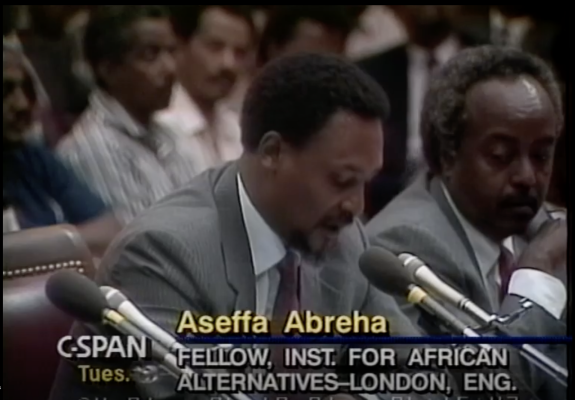
Rutha Bahlibi: [01:05:55] The 1991 U.S. hearing included testimonies representing various political perspectives, including an Eritrean representative advocating for secession, and Aseffa Abreha, an EPRDF-aligned participant.* Here is what Aseffa Abreha stated.
Aseffa Abreha: [01:06:15] "Some individuals of the exiles in Washington find it difficult to accept the glorious victories of the people of Ethiopia over the tyrannical regimes. It is ironic that, rather than celebrate the fall of tyranny, some of the exiles are making frantic attempts to stir up conflicts among the various ethnic groups of Ethiopia. They have been making inflammatory rhetoric to foster ethnic divisions and animosity. It should be noted that some individuals of the exiles in Washington who are shedding crocodile tears were the very people who helped design the tyrannical system and carry out its atrocities against the Ethiopian people in the country.
[01:06:55] If their actions and rhetoric are anything to go by, they must have been beneficiaries of the defunct tyrannical system. They are so desperate about the victories of the people that they claim so much through some of their mouthpieces in the press—such as that the Tigrayans are occupation forces, they are invading forces, and that they are a minority, et cetera. It is against the democratic aspirations of the people of Ethiopia if the previous ruling elites, who came from a minority, should be replaced by another minority. When speaking of numbers, however, it should be remembered that much as they paid huge sacrifices to protect the independence of Ethiopia in the past, the people of Tigray have paid disproportionately immense sacrifice during the struggle to defeat the totalitarian regime. Having said that, it should be added that the people of Tigray aspire for a peaceful and democratic resolution of the conflict to bring about equality and progress. They want, together with the other Ethiopian compatriots, to build a democratic Ethiopia where everyone feels they belong, where discrimination against nationality and religion is abolished once and for all, and an Ethiopia where there will not be any second-class citizens anymore. What those individuals, exiles, claim and think—whatever they think—the popular democratic struggle has defeated the tyrannical system because the people not only support it, but fully participate in it. The struggle has succeeded because it is an authentically democratic and popular struggle led by Revolutionary Democratic forces.
[01:08:38] What does one understand by unity in the Ethiopian context? Is it territorial or peoples' unity that one is talking about? Whose interest does unity serve? These questions must be seriously tackled. The issue of unity cannot be viewed in isolation from the democratic question. They are interrelated. If unity is to serve the interests of the people, it has to be brought about by themselves. Unity cannot be sustained by the use of force. There is no difference between unity and democracy. The people expected democracy from the 1974 revolution, [but] when the Derg took over power, the situation got from bad to worse. The suppression was more intensified. The policy of oppression continued unabated. Yet, the Derg continued with a slogan of unity and committed horrifying atrocities against the people in various areas of the country. However, unity did not come about. Instead, the struggle against oppression and for democracy got strengthened and spread throughout the country. So, the question then is: if there is democracy, there is no reason why there would not be unity. Unity is mutual. People live in unity in order to serve their own interests and not to do favors to others. Unity can come about on the basis of mutual interests. If, on the other hand, oppression and coercion continue, there would not be unity and the country could be disintegrated.
Explanatory Notes
¹ Harambee Today was unable to verify the number of TPLF casualties during this period.
² Harambee Today was unable to verify the total military and civilian casualties under the Derg regime.
Credits & Archival Sources
Human Rights Watch – Video documentation on the Irreecha Festival massacre (September 19, 2017)
C-SPAN Video Library Archives:
- Civil War and Famine in Ethiopia (June 18, 1991)
- Paul Henze Testimony: Famine and Civil War in the Horn of Africa (May 30, 1991)
- Ethiopian Famine Congressional Hearing (April 21, 1988)